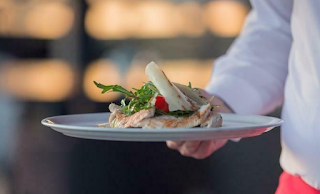
As you read this story, contemplate how it maps to traditional ineffective and inadequate discovery and demos.
[There will be a self-quiz at the end, referencing the [Numbers] in the story – see how you do!]
Imagine that you and four colleagues are a bit hungry and decide to have a bite. You’ve explored the advertising and online reviews for several restaurants, and you choose one that seems like a good possibility, based on what you are looking for.
You enter and are met by the host who asks, “Are you hungry?”
You respond, “Yes, a bit…”
The host inquires, “Would you prefer indoors or patio seating?”
You reply, “We’d like to sit indoors, please…” [1]
The host guides you into the lobby and presents a series of posters that describe the restaurant’s origins and history, the location of sister restaurants in the area, its farm-to-table ethic, hours, capacity, banquet and special event options, several framed reviews of the restaurant (which you’ve already read online) and quotes from several “famous” guests (that you’ve never heard of). [2]
Your host asks, “Any questions so far?”
You respond, “Nope, we’re good…” as you wonder when you’ll be seated. Sadly, not yet!
You are taken into the kitchen to see the various preparation stations and are introduced to the staff. They each describe their background, current job title and when they joined the restaurant team. Next, the chef provides a verbal overview and history of the main dishes and many of the options available. [3]
Your host asks, “Any questions so far?”
You respond, “Nope, we’re good…” as you again wonder when you’ll be seated.
Finally, you are steered out of the kitchen to a map showing the locations of the various dining areas including both “public” and “private” rooms along with navigation directions. Your host comments that, “All these rooms are fully configurable…” [4]
Meanwhile, your appetite has been growing…
Your host takes you to a very large table, noting, while simultaneously demonstrating how “You can configure this table in a variety of ways, including rectangular, round, and square, with as many as twenty seats or as few as one…” [5]
“Thanks,” you say, “but we are just a party of five. We don’t need a huge table…”
The host replies cheerily, “No worries! Let me introduce you to your waiter…”
“Hi folks! I’m Taylor and I’ll be taking care of you tonight.” Taylor adds, as the host lingers near the table (for the entire meal), “I’ve been a waiter for ten years. I used to be a regular at this restaurant.” [6]
You reply, “Good to hear…” as you wonder if you’ll ever see a menu.
Taylor then points out that “The silverware, plates, napkins, glasses, tablecloth, salt/pepper, condiments, and flower vase can all be configured as desired. If you have young children, for example, you can remove the knives and glasses for safety. You can even seat them at a separate table with limited options!”
You glance at your colleagues – everyone is an adult in your party.
Taylor continues, “You can also configure the chairs and table height, in addition to the shape and size, and we have extensive facilities for handicapped folks. The chairs can also be equipped with rollers, but that is an extra charge… Any questions so far?” [7]
“No…” you respond as you take seats at one end of the now oblong table.
“No worries…!” says Taylor. “Now, here’s the plan for your dinner. We’ll be bringing out all of our appetizers, soups, salads, mains and sides, as well as desserts (if we don’t run out of time). We’ll also be pouring beer, cider, wine, water, port, sherry, liquors (we have whiskey, bourbon, scotch, gin, rum, brandy, and hundreds of other choices), as well as a broad range of juices and soft drinks. And, of course, the amount of food is fully configurable, so if you want a banquet for 100 folks or are just a single diner we have you covered! Plate and drink sizes can be configured, as well, from huge platters and barrels to tiny amuse-bouche and single shots.” [8]
At this point, you are both excited and concerned about the possible length of the meal. You’ve got a meeting to join in just 90 minutes!
Taylor continues by discussing restaurant security, including detailed descriptions of how the doorman checks IDs before allowing entry, how credit card info is handled, and then delivers a safety briefing in case of fire, flood, earthquake, lightning strike, power loss, gas leak, choking, and other potential disasters. [9]
Taylor asks, “Any questions on security?”
“No, but thanks for that comprehensive explanation…” you reply, a bit sarcastically.
Taylor then says, “Let’s now show you how you can organize a place setting for your specific desires…” as Taylor removes everything from one of the seating locations.
“Here, you can have as many forks as you want, including fruit, cake, dessert, dinner, fish, and roast (the biggest, which requires special permissions); the same with knives, such as dessert, butter, dinner, steak, fish, and carving (again, requiring special permissions and proof of certification for use); we also offer an abundance of spoons as well, such as sugar, soup, salad, serving, dinner, coffee, tea, ice cream and soda spoons. They can all be configured depending your dining interests” continues Taylor while setting and removing multiple examples. [10]
“What do you think of your meal so far?” asks Taylor.
There are some low-voiced comments of concern from your colleagues, expressing impatience, but you respond, “It’s fine so far…”
You are expecting that Taylor will now distribute menus and are surprised when that doesn’t take place. Instead, Taylor says, “Next, we’ll serve an overview of our dishes!” and heads to the kitchen. [11]
For the next 75 minutes, Taylor brings plate after plate and dish after dish to the table. Taylor presents each one asking, “Is this something you’d like?” (or similar inquiry) and then places each on the table, until the surface is covered with an enormous variety of preparations.
Appetizers appear, followed by a bevy of breads and butters, rolls and relishes, salads and soups, crudité and croutons, cereals and sprouts, lettuces and legumes, bisques and braises, steaks and sauces, roasts and ragouts, fish and fowl, stews and sautés, shellfish and sushi… “Anything look good so far?” asks Taylor. [12]
And with every dish presented, Taylor comments, “Now, if you want larger or smaller portions, here’s what they look like…” and Taylor shows 3-4 options of each. “Or, if you want combinations, we’ve got that covered as well…!” while demonstrating how two or more can be combined, re-apportioned, or mixed. [13]
“Any questions on what we’ve served so far?” queries Taylor.
“Um, no…” you respond a bit uncomfortably.
During this smorgasbord of a culinary journey you note:
- There are many dishes you’d never contemplate consuming, but require special, expensive equipment to prepare. It makes you wonder if you may be paying for capabilities you don’t need. [14]
- Some dishes trigger allergies with you and your colleagues, “Oh no! Must be peanuts in this preparation – grab my EpiPen!”
- Several of your colleagues have specific food requirements, including Halal, Kosher, vegetarian and pescatarian – none of which were revealed until plates of sizzling pork cutlets were served to everyone… [15]
You also note that your available time is rapidly being consumed. Strangely, Taylor never seems to note that none of you are eating anything! Taylor begins to get a bit desperate and increases the pace of the show…
Taylor signals to more waitstaff, who bring and serve a deluge of drinks and a bevy of beverages: flasks and flagons, glasses and goblets, cups and carafes, steins and shots, demitasse and decanters, sippy-cups and straws, along with a colossal collection of cocktails (including, but not limited to: Monkey Gland, Mitch Martini, Painkiller, Brandy Alexander, Japanese Slipper, Greyhound, Hedgerow Sling, Caipiríssima, Lynchburg Lemonade…). [12 again]
Taylor asks, while panting slightly from the exertion, “Any questions so far?”
“No, but…” you begin, but Taylor isn’t paying attention. [16]
Instead, Taylor announces, triumphantly, “Well, we’ve saved the best for last: dessert!” [17]
You respond, “Well, the good news is that dessert is exactly what we wanted – just a nice bite of something sweet and tasty – but now we’re out of time and must leave for a meeting.”
The host, who had been lingering in the background throughout the entire performance, steps up and says, “Should we schedule another meal?” [18]
You reply, politely, “We’ll let you know…” as you gather your things and head for the exit. You are frustrated with the experience and disappointed. All you wanted was a tasty sweet, just as you had seen in the restaurant’s advertising!
As your group heads for the meeting, one of your colleagues proclaims, “I’ll never eat there again!” This sentiment is seconded by all.
Self-Quiz
Map the story to typical, potentially sad vendor behaviors in discovery and demos. The sad story segment is repeated for your convenience (and amusement), followed by the Quiz Question(s) and the Answer(s). Enjoy!
[1] You enter and are met by the host who asks, “Are you hungry?”
You respond, “Yes, a bit…”
The host inquires, “Would you prefer indoors or patio seating?”
You reply, “We’d like to sit indoors, please…”
[Quiz] What process was going on here? Was it sufficient?
[Answer] Discovery, and no. Sadly, all that was uncovered was a confirmation of pain (“hungry”) and one element of the prospect’s environment/tech stack (“indoors”).
[2] The host guides you into the lobby and presents a series of posters that describe the restaurant’s origins and history, the location of sister restaurants in the area, its farm-to-table ethic, hours, capacity, banquet and special event options, several framed reviews of the restaurant (which you’ve already read online) and quotes from several “famous” guests (that you’ve never heard of).
[Quiz] What was happening here? Was it necessary?
[Answer] The dreaded corporate overview. Was it necessary? Nope.
[3] You are taken into the kitchen to see the various preparation stations and are introduced to the staff. They each describe their background, current job title, and when they joined the restaurant team. Next, the chef provides a verbal overview and history of the main dishes and many of the options available.
[Quiz] How about this? What was not explored?
[Answer] Introductions of the vendor’s team weren’t explored. Note that the vendor never inquired about the prospect’s team. Another, simple element of doing discovery.
[4] Finally, you are steered out of the kitchen to a map showing the locations of the various dining areas including both “public” and “private” rooms along with navigation directions. Your host comments that, “All these rooms are fully configurable…”
[Quiz] We’ve now moved into what part of the meeting? Was it compelling?
[Answer] The demo, starting with how to navigate the software generally. Was this a compelling start to the demo? Nope.
[5] Your host takes you to a very large table, noting while simultaneously demonstrating how “You can configure this table in a variety of ways, including rectangular, round, and square, with as many as twenty seats or as few as one…”
[Quiz] And this? Is it important?
[Answer] This is known as “Set-up Mode”, describing how you can configure your home screen. Not particularly useful!
[6] “Hi folks! I’m Taylor and I’ll be taking care of you tonight.” Taylor continues, as the host lingers near the table (for the entire meal), “I’ve been a waiter for ten years. I used to be a regular at this restaurant.”
[Quiz] Who’s this? Are you comfortable taking recommendations from Taylor?
[Answer] The technical expert, most likely a presales person. Even if you came from the industry as a customer or user, once you’ve joined a vendor you are no longer perceived as trustworthy – you’ll have to earn that trust again! And note that the “host” is the salesperson in our story…
[7] Taylor continues, “You can also configure the chairs and table height, in addition to the shape and size, and we have extensive facilities for handicapped folks. The chairs can also be equipped with rollers, but that is an extra charge… Any questions so far?”
[Quiz] How about this?
[Answer] More Set-up Mode, sadly, and it was completely irrelevant for this prospect. How often does this occur in demos? This is another example of insufficient discovery compounded by following the “standard” demo pathway.
[8] “No worries…!” says Taylor. “Now, here’s the plan for your dinner. We’ll be bringing out all of our appetizers, soups, salads, mains and sides, as well as desserts (if we don’t run out of time). We’ll also be pouring beer, cider, wine, water, port, sherry, liquors (we have whiskey, bourbon, scotch, gin, rum, brandy, and hundreds of other choices), as well as a broad range of juices and soft drinks. And, of course, the amount of food is fully configurable, so if you want a banquet for 100 folks or are just a single diner you are covered! Plate and drink sizes can be configured, as well, from huge platters and barrels to tiny amuse-bouche and single shots.”
[Quiz] This frightening list is what?
[Answer] It’s the agenda for the demo. Note that it is the vendor’s agenda and may not (and certainly did not) reflect the prospect’s desires.
[9] Taylor continues by discussing restaurant security, including detailed descriptions of how the doorman checks IDs before allowing entry, how credit card info is handled, and covers a safety briefing in case of fire, flood, earthquake, lightning strike, power loss, gas leak, choking, and other potential disasters.
[Quiz] And this portion?
[Answer] Login permissions and security, one of the surest ways to have your demo derailed by IT before it even leaves the station!
[10] Here, you can have as many forks as you want, including fruit, cake, dessert, dinner, fish, and roast (the biggest, which requires special permissions); the same with knives, such as dessert, butter, dinner, steak, fish, and carving (again, requiring special permissions and proof of certification for use); we also offer an abundance of spoons as well, including sugar, coffee, tea, soup, salad, serving, dinner, ice cream and soda spoons. They can all be configured depending your dining interests” continues Taylor while setting and removing multiple examples.
[Quiz] O.M.G.
[Answer] How many times have you seen this with demos, and particularly demos done without sufficient discovery? This is “Set-up Mode” at its worst!
[11] You are expecting that Taylor will now distribute menus and are surprised when that doesn’t take place. Instead, Taylor says, “Next, we’ll serve an overview of our dishes!” and heads to the kitchen.
[Quiz] What’s happening here?
[Answer] This is the beginning of a traditional “overview” demo or attempted “disco demo”. Fasten your seatbelt (or perhaps loosen your belt) for what is to come!
[12] Appetizers make their appearance, followed by a bevy of breads and butters, rolls and relishes, salads and soups, crudité and croutons, cereals and sprouts, lettuces and legumes, bisques and braises, steaks and sauces, roasts and ragouts, fish and fowl, stews and sautés, shellfish and sushi… “Anything look good so far?” asks Taylor.
[And]
Taylor signals to more waitstaff, who bring and serve a deluge of drinks and a bevy of beverages: flasks and flagons, glasses and goblets, cups and carafes, steins and shots, demitasse and decanters, sippy-cups and straws, along with an entire orchestra of cocktails (including, but not limited to: Monkey Gland, Mitch Martini, Painkiller, Brandy Alexander, Japanese Slipper, Greyhound, Hedgerow Sling, Caipiríssima, Lynchburg Lemonade…).
[Quiz] These sections are known as the dreaded what?
[Answer] That’s right, it’s the dreaded Harbor Tour (often thinly disguised, by name, as a “disco demo”). Stunningly awful!
[13] With every dish presented, Taylor comments, “Now, if you want larger or smaller portions, here’s what they look like…” and Taylor shows 3-4 options of each. “Or, if you want combinations, we’ve got that covered as well…!” while demonstrating how two or more can be combined, re-apportioned, or mixed.
[Quiz] How do you take an awful demo and make it worse?
[Answer] Explore every “if”, “or” and “also” possibility…!
[14] There are many dishes you’d never contemplate consuming, but require special, expensive equipment to prepare. It makes you wonder if you may be paying for capabilities you don’t need.
[Quiz] What is this called?
[Answer] “Buying It Back” – causing prospects to demand a price reduction, since they are unwilling to pay for capabilities they won’t use.
[15] Several of your colleagues have specific food requirements, including Halal, Kosher, vegetarian and pescatarian – none of which were revealed until plates of sizzling pork cutlets were served to everyone…
[Quiz] What was not done that could have avoided this?
[Answer] Everyone say it together, with passion, “Discovery!!!”
[16] Taylor asks, while panting slightly from the exertion, “Any questions so far?”
“No, but…” you begin, but Taylor isn’t paying attention.
[Quiz] Ooooo… This is bad and likely won’t end well!
[Answer] The vendor rep is not exhibiting “Active Listening” – clearly a recipe for disaster (pun intended).
[17] Instead, Taylor announces, triumphantly, “Well, we’ve saved the best for last: dessert!”
[Quiz] How many times have you heard this in demos?
[Answer] Annnnnnnd the vendor (once again) ran out of time before getting to the “best stuff”.
[18] The host, who had been lingering in the background throughout the entire performance, steps up and says, “Should we schedule another meal?”
[Quiz] Or this, at the end of traditional demo and disco-demo meetings?
[Answer] This is the salesperson living in the “Land of Hope”!
How many did you get correct? More importantly, how many of these do you or your team suffer from?
Lessons and Solutions
First, a little (more) discovery could have rather dramatically improved this engagement. Here are a few questions, for example, that might have saved everyone (restaurant and diners aka vendor and prospect) a great deal of pain:
Host: “Is there anything in particular that you are looking for?”
You: “Yes, we’re here to try a dessert or two…”
Host: “Terrific – something specific?”
You: “Well, we’re all big fans of chocolate…”
Host: “Any food limitations or allergies to be aware of?”
You: “Yes, we have Halal, Kosher, and vegetarians in our group – and one of us has a pretty strong peanut allergy. Can we see the dessert menu, please?”
Wait! What was that last request? “Ummm… Can we see the dessert menu?”
A menu! What a delightful solution to the challenge of communicating what the restaurant can serve. The Menu Approach is a similarly delightful solution for software vendors offering a range of solutions, products, capabilities and options.
But wait: what could potentially improve upon a menu? Compare the following two scenarios:
Scenario One:
You: “Can we see the dessert menu?”
Host: “Certainly, here you go” and paper menus are passed to each diner, with the following list of offerings:
- Luscious Dark Chocolate Gateaux
- Homemade Tahitian Vanilla Ice Cream
- Trio of Fresh Fruit Sorbets
- Salted Caramel Crème Brûlée
- Black Walnut and Orange Torte
Sounds good! Which would you choose?
Scenario Two:
You: “Can we see the dessert menu?”
Host: “Certainly, here you go” and paper menus are passed to each diner, with the same list of desserts. At the same time, the host calls for the waiter, “Taylor, can you please bring the dessert tray over here?”
Taylor does so and now you are looking at all five offerings, exquisitely displayed. Mouths water. Nostrils inhale delectable scents. Stomachs rumble in anticipation.
One of your party exclaims, “Wow! I wasn’t planning to have anything, but these look so good I just have to try one…!”
What’s the difference between these two scenarios?
Vision Generation has taken place! Actually seeing an example of the end deliverable is much more compelling than a verbal or written description. The same principle applies to demos.
Upskilling
In our story above, the host and waiter (salesperson and presales practitioner) exhibited traditional, insufficient approaches to discovery and demos. In addition to the articles links above, here are additional paths to improvement:
- The Doing Discovery methodology is an opportunity to dramatically improve your discovery skills and outflank your competition, right from the beginning of the engagement.
- Great Demo! is a pathway to stunningly compelling, successful demos. The two leverage one another, providing you with validated processes for crisper closes and happier customers.
In addition to these resources, you might consider live training sessions:
- Seminars/Webinars: to introduce new concepts, stimulate thinking, and begin the process of change;
- Workshops – face-to-face or virtual – to implement and achieve broad adoption.
Bon appétit!
Copyright © 2022 The Second Derivative – All Rights Reserved.