Ken Molay, a web presentation expert, suggests the idea of “move and stop, move and stop” when delivering demos over the web. Specifically, he recommends using your mouse to deliberately move to a location and then stop and leave the mouse still while you offer a brief verbal description; then move and stop again.
This practice gives the audience sufficient time to follow the mouse movements, particularly if there is a delay or latency in the web session. It also provides the audience with a brief respite from an otherwise constantly moving mouse!
While Ken makes this suggestion with regards to Remote Demos, the same principle can certainly be applied to face-to-face sessions.
More on Ken and his thoughts can be found at http://www.wsuccess.com/.
Thursday, May 29, 2008


Tuesday, May 27, 2008
Long Email Streams – Refresh Contact Info
When you are responding to customer email that is the result of a series of messages sent back and forth, you may want to occasionally refresh your contact information by including it in your most recent response.
This will help your customer find your phone number or other contact information more easily, should they wish to use it. Otherwise they may have to scroll all the way down to the beginning of the email stream to find your contact info.
This may be even more important for Blackberry (and similar device) users. In many cases, Blackberry users cannot scroll to the beginning of an email stream since the Blackberry is limited on the length of the message it supports – much of the original traffic may have been truncated.
This will help your customer find your phone number or other contact information more easily, should they wish to use it. Otherwise they may have to scroll all the way down to the beginning of the email stream to find your contact info.
This may be even more important for Blackberry (and similar device) users. In many cases, Blackberry users cannot scroll to the beginning of an email stream since the Blackberry is limited on the length of the message it supports – much of the original traffic may have been truncated.
Thursday, May 22, 2008
The Real Competition
According to statistics I heard cited in a recent webinar, executives today face the following daily “pile”:
- 59 hours of work to be done (that day, conceptually) is sitting on their desks
- Their day is largely booked with meetings
- They receive ~150 email messages
- They receive ~29 voicemail messages
Now tell me again why they should listen to your 20 minute corporate overview presentation or wait through 40 minutes of demo to hear the punch line?
- 59 hours of work to be done (that day, conceptually) is sitting on their desks
- Their day is largely booked with meetings
- They receive ~150 email messages
- They receive ~29 voicemail messages
Now tell me again why they should listen to your 20 minute corporate overview presentation or wait through 40 minutes of demo to hear the punch line?
Monday, May 19, 2008
Probe Probes
Very often, when a customer asks a question in a demo, you have an opportunity at hand to expand vision, achieve competitive differentiation, or reinforce value. Too often, we don’t take advantage of these opportunities…!
Frequently, we answer questions directly, rather than probe for further understanding before providing an answer. Jumping too rapidly to an answer is where we lose our opportunity.
For an example, let’s say that you provide a SaaS (software as a service) offering that runs equally well on Macintosh and Windows versions of Internet Explorer (but your competition only supports Windows)…
Case One – the Lost Opportunity:
During your demo, a customer asks, “Do you support Macintosh?”
You answer, “Yes, we do” and then continue with your demo. You’ve clearly squandered the opportunity to support this further. [They could simply be curious; they could be interested in a handful of machines or a pile of Macs; you just don’t know…]
Case Two – Opportunity Seized:
During your demo, a customer asks, “Do you support Macintosh?”
You answer, “Yes, we do” and then follow with, “Why do you ask?”
The customer replies, “Well, we are about 50% Macs these days and Mac support is critical. Some other vendors either don’t support Mac at all or do it poorly”.
You comment, “Thanks – the Macintosh is a key platform for us and our current customers, and our product roadmap for future releases continues to emphasize this.” [Ah ha! Mac is a very important issue for them and you have a huge competitive advantage…!]
The moral? Contemplate “probing probes” when you believe you may have appropriate opportunities.
Frequently, we answer questions directly, rather than probe for further understanding before providing an answer. Jumping too rapidly to an answer is where we lose our opportunity.
For an example, let’s say that you provide a SaaS (software as a service) offering that runs equally well on Macintosh and Windows versions of Internet Explorer (but your competition only supports Windows)…
Case One – the Lost Opportunity:
During your demo, a customer asks, “Do you support Macintosh?”
You answer, “Yes, we do” and then continue with your demo. You’ve clearly squandered the opportunity to support this further. [They could simply be curious; they could be interested in a handful of machines or a pile of Macs; you just don’t know…]
Case Two – Opportunity Seized:
During your demo, a customer asks, “Do you support Macintosh?”
You answer, “Yes, we do” and then follow with, “Why do you ask?”
The customer replies, “Well, we are about 50% Macs these days and Mac support is critical. Some other vendors either don’t support Mac at all or do it poorly”.
You comment, “Thanks – the Macintosh is a key platform for us and our current customers, and our product roadmap for future releases continues to emphasize this.” [Ah ha! Mac is a very important issue for them and you have a huge competitive advantage…!]
The moral? Contemplate “probing probes” when you believe you may have appropriate opportunities.
Tuesday, May 13, 2008
Integrating Sales into Demos
Here’s a question regarding integrating sales people into a demo:
“I was wondering if you could point me specifically to any thoughts you have about Sales and Presales working in tandem in a sales call. Over the years I have personally experienced some Sales reps briefly introducing themselves, then introducing me - and then saying ‘now watch Bob for the rest of the hour’. They sit back and expect me to run the sales call with my demo.
I'm wondering if you have any best practices we can reference to improve this interaction?”
This is a terrific and very important topic..! Yes, there are a number of practices and methods to apply that integrate the sales people into the demo. Here are a few:
Use a “Situation Slide” to introduce the customer’s situation at the start of the demo – I recommend that the sales person does this part.
- Follow with an “Illustration” of the end result or results – sales or presales can do this. Sales should then “hand-off” to the Presales person, but remain engaged…
- Sales people should occasionally do a summary of the demo, or demo segment, to both help the audience remember what they are seeing and to break up what may otherwise be a gush of features…!
- Sales should help “queue” questions (via a “Not Now” List or “Parking Lot”) to help manage the flow of the demo and to avoid going off into technical details too early (or when high-ranking customer representatives are present).
- Sales should be prepared to step in if an AE encounters a serious bug or crashes – to call a break, cover the projector, and redirect attention to the list of questions (for example).
- Both parties can “rescue” the other (e.g., going too deep answering a question, remembering to summarize a key point or segment, etc.).
- Both the Sales person and Presales person should be in the front of the room during the demo, as well, to support the above processes and practices.
- Doing demos remotely (e.g., via WebEx or GoToMeeting) offers a broad set of opportunities for team play. Having the sales person present at the customer enables higher success rates, as the role of the sales person is to be an active set of eyes and ears for the technical colleague located remotely.
In our Great Demo! Workshops we suggest that a demo should be perceived by the customer as a conversation, rather than a one-way presentation. The role of sales is to help facilitate this conversation – and to be an active listener.
Other suggestions?
Friday, May 9, 2008
Change “Test” or “Demo” to “Production”
We've commented previously that using the words "test" or "demo" for file names, examples accounts and other similar uses in demos it not recommended - it tells the customer that the application they are seeing is not "real".
One simple solution is to change every use of "demo" or "test" to "production". This generates the impression that it truly is a real environment...!
One simple solution is to change every use of "demo" or "test" to "production". This generates the impression that it truly is a real environment...!
Tuesday, May 6, 2008
Great / Awful Demo...
Here's a very interesting recorded demo to check out:
http://www.disruptormonkey.com/foundry/
Comments?
Here’s what I liked:
- REALLY liked the “before” situation – very compellingly presented.
- The groovy music, rather than a “professional” voice-over with background thrumming…
- The recording/playback technology looks like a nice tool.
Here’s what I thought they could do better:
- What the heck is the deliverable??? What business process is this improving (web searching and information collection, I assume)?
- Make it easy to take action. The company name and URL or phone should have been displayed long and last, with opportunity to click.
http://www.disruptormonkey.com/foundry/
Comments?
Here’s what I liked:
- REALLY liked the “before” situation – very compellingly presented.
- The groovy music, rather than a “professional” voice-over with background thrumming…
- The recording/playback technology looks like a nice tool.
Here’s what I thought they could do better:
- What the heck is the deliverable??? What business process is this improving (web searching and information collection, I assume)?
- Make it easy to take action. The company name and URL or phone should have been displayed long and last, with opportunity to click.
Vendors for Recorded Demos
What vendors have you worked with that build recorded demos for online or website use? What have your experiences been?
Here are the URL’s for three companies offering services in this area. Are there others to consider?
http://www.flickerbox.com/
http://www.vtdemos.com/
www.Autodemo.com
Here are the URL’s for three companies offering services in this area. Are there others to consider?
http://www.flickerbox.com/
http://www.vtdemos.com/
www.Autodemo.com
Monday, May 5, 2008
How Many Visits per $100K?
During a call with a prospect today, the idea surfaced that there appears to be a relationship between the number of customer visits (or virtual meetings) required to secure each $100K of an order.
For example, an order of $100K might typically require 2-3 visits, plus an additional customer visit for each additional $100K in the deal. A $1M order would thus consume 10-12 visits.
Comments?
For example, an order of $100K might typically require 2-3 visits, plus an additional customer visit for each additional $100K in the deal. A $1M order would thus consume 10-12 visits.
Comments?
Thursday, May 1, 2008
The W Key in Remote Demos
In PowerPoint Slideshow mode, the “B” key can be used to toggle between your presentation and a black screen. This can be very effective in face-to-face presentations when you want to direct the audience’s attention away from the screen. You can achieve a similar effect in Remote Demos (using WebEx, GoToMeeting, etc.) by using the “W” key.
In PowerPoint’s Slideshow mode, pressing “W” turns your screen white. If you want to draw your audience’s attention away from the computer screen in a Remote Demo, use the W key and say, “I’ve just blanked the screen…” The white lets the audience know that the web conferencing session is still active.
It is a nice tool and technique – try it!
In PowerPoint’s Slideshow mode, pressing “W” turns your screen white. If you want to draw your audience’s attention away from the computer screen in a Remote Demo, use the W key and say, “I’ve just blanked the screen…” The white lets the audience know that the web conferencing session is still active.
It is a nice tool and technique – try it!
Tuesday, April 29, 2008
Friday Fun: How (not) to use PowerPoint
This video is WAY too fun (and funny and pointed...)!
http://lawprofessors.typepad.com/law_librarian_blog/2007/04/friday_fun_how_.html
http://lawprofessors.typepad.com/law_librarian_blog/2007/04/friday_fun_how_.html
Tuesday, April 8, 2008
Dead-ends…
Avoid dead-ends. Let me say that again: avoid dead-ends. I recently watched a demo where the presenter explored what seemed to be all possible potential pathways to complete a single task. What could have been completed in about 30 seconds – about 5 mouse clicks – took 24 minutes!
The presenter pursued two sets of non-productive pathways:
- Alternative approaches (“…and another way to do this is to…”)
- Dead-ends (“…but for this example we won’t do that and instead we’ll go back to where we were a moment ago…”)
The end result was a Stunningly Awful Demo, perceived as too complicated, too convoluted, and too complex by the audience.
When you have the option to present a range of pathways or related capabilities, choose the highest probability pathway for the customer at hand and execute that pathway with the fewest number of steps to complete the task.
To be fair, there may be situations where some of these alternative approaches or dead-ends may be useful or even important. An excellent way to test for interest in exploring any alternative approaches or capabilities represented by dead-ends is to ask.
For example, “Are you interested in seeing how you can do this task using the menus instead of the wizard we just used?”
Or, “We have a number of other output options – are there any output formats that you would like to see in particular?”
Otherwise, avoid alternative approaches and dead-ends…!
The presenter pursued two sets of non-productive pathways:
- Alternative approaches (“…and another way to do this is to…”)
- Dead-ends (“…but for this example we won’t do that and instead we’ll go back to where we were a moment ago…”)
The end result was a Stunningly Awful Demo, perceived as too complicated, too convoluted, and too complex by the audience.
When you have the option to present a range of pathways or related capabilities, choose the highest probability pathway for the customer at hand and execute that pathway with the fewest number of steps to complete the task.
To be fair, there may be situations where some of these alternative approaches or dead-ends may be useful or even important. An excellent way to test for interest in exploring any alternative approaches or capabilities represented by dead-ends is to ask.
For example, “Are you interested in seeing how you can do this task using the menus instead of the wizard we just used?”
Or, “We have a number of other output options – are there any output formats that you would like to see in particular?”
Otherwise, avoid alternative approaches and dead-ends…!
Monday, April 7, 2008
A Solution to "Death by PowerPoint" - In Nine Minutes
Gavin Meikle has put together a very nice, compact (nine minute) video that provides a simple set of solutions to the typical misuses of PowerPoint. He effectively summarizes the key messages in Cliff Atkinson’s book Beyond Bullet Points in a compact, easily consumable format.
Here’s the link to his video/presentation: http://www.trainingdesign.be/2008/01/20/its-powerpoint-jim-but-not-as-we-know-it/
Here’s the link to his video/presentation: http://www.trainingdesign.be/2008/01/20/its-powerpoint-jim-but-not-as-we-know-it/
Friday, April 4, 2008
Yet More Auto-Demo Hell - A "Customized" Recorded Demo?
Should a recorded or canned demo by “customized”? Interesting and tough challenge…!
By definition, recorded demos are not customized for any specific customer. However, an attempt to create a single recorded demo that embraces the needs and situations of a range of prospects with different job titles in differing markets is likely doomed to fail.
Example: Consider CRM demos that try to cover the needs of salespeople, sales management, and marketing. Sales management is most interested, typically, in forecast accuracy and transparency – which relies upon data entry by salespeople. A demo that shows a rep entering a pile of pipeline information (deal size, key players, likely close date, probability, deal stage, etc.etc.) will likely please the VP of sales but annoy the sales reps.
Similarly, the above scenario does little to help a marketing manager charged with executing lead generation campaigns – her demo needs to speak to the results and processes of campaign execution and management.
In summary, recorded demos need to be “customized” at least to address relevant market- and job-title specific situations. Recorded demos that show no apparent effort to customize are likely to:
1. Be perceived as insulting by the customer (“we are not all alike”)
2. Will result in more work for the vendor to get the same business (“I didn’t see what I needed in your demo – and it appeared to be inflexible”)
3. Violates nearly every customer-centric principle (and certainly the core principles of the Great Demo! method)
When I’m working with customers to help with their recorded demos (e.g., hosted on their websites), I recommend a Menu Approach to lead each individual prospect to the specific, generically-customized demo that matches that customer’s industry and job-title. That means, potentially, multiple recorded demos as opposed to a single demo that hopes to somehow embrace everyone.
Does this mean that you need to generate recorded demos for every target job title and market? Yes and no…
Yes; in that the prospect should perceive that they have been led to a demo that is specifically relevant for them. No; you should expect that the situations for many job titles will be reasonably homogeneous across markets – providing the ability to leverage one recorded demo across those markets. (You’ll need to be careful/clever about what data is used). Often, you can apply different voice-overs to one core demo to lend the appearance of a recorded demo that has been customized for a specific target audience.
The perception that a recorded demo has been created specifically for an audience can truly accelerate the sales cycle!
By definition, recorded demos are not customized for any specific customer. However, an attempt to create a single recorded demo that embraces the needs and situations of a range of prospects with different job titles in differing markets is likely doomed to fail.
Example: Consider CRM demos that try to cover the needs of salespeople, sales management, and marketing. Sales management is most interested, typically, in forecast accuracy and transparency – which relies upon data entry by salespeople. A demo that shows a rep entering a pile of pipeline information (deal size, key players, likely close date, probability, deal stage, etc.etc.) will likely please the VP of sales but annoy the sales reps.
Similarly, the above scenario does little to help a marketing manager charged with executing lead generation campaigns – her demo needs to speak to the results and processes of campaign execution and management.
In summary, recorded demos need to be “customized” at least to address relevant market- and job-title specific situations. Recorded demos that show no apparent effort to customize are likely to:
1. Be perceived as insulting by the customer (“we are not all alike”)
2. Will result in more work for the vendor to get the same business (“I didn’t see what I needed in your demo – and it appeared to be inflexible”)
3. Violates nearly every customer-centric principle (and certainly the core principles of the Great Demo! method)
When I’m working with customers to help with their recorded demos (e.g., hosted on their websites), I recommend a Menu Approach to lead each individual prospect to the specific, generically-customized demo that matches that customer’s industry and job-title. That means, potentially, multiple recorded demos as opposed to a single demo that hopes to somehow embrace everyone.
Does this mean that you need to generate recorded demos for every target job title and market? Yes and no…
Yes; in that the prospect should perceive that they have been led to a demo that is specifically relevant for them. No; you should expect that the situations for many job titles will be reasonably homogeneous across markets – providing the ability to leverage one recorded demo across those markets. (You’ll need to be careful/clever about what data is used). Often, you can apply different voice-overs to one core demo to lend the appearance of a recorded demo that has been customized for a specific target audience.
The perception that a recorded demo has been created specifically for an audience can truly accelerate the sales cycle!
Thursday, April 3, 2008
More on Auto-Demo Hell…
A recent Great Demo! Workshop participant (from his marketing department) shared a challenge he was facing: His boss asked him to prepare a recorded demo that could be hosted on their website right away to support the launch of a new version of their product.
When he (wisely) asked some of his sales counterparts for input on the draft demo, he was told:
- Looks great!
- Looks awful!
- Perfect for my customers!
- Totally wrong for my customers!
What was happening?
After discussion, it became clear that the sales team is organized into two major groups: “Hunters”, who work to secure new business and “Farmers”, who’s role is to develop existing customers. The Farmers loved the demo and the Hunters despised it. Why? Because the demo focused on the new capabilities recently released.
Current customers are, generally speaking, attuned to the typical use cases for the software. They generally “get it” with respect to the possible uses for new features and capabilities that are provided in a new release. A demo that focuses on these new features may be adequate for current customers. (Note that using Situation Slides that summarize the intended use cases will be more successful than a demo that simply highlights capabilities).
On the other hand, new prospects may have no context and will likely be confused when presented with a feature-based demo. A demo that focuses on a set of new features will be even more confusing – it assumes a base understanding of the software already released.
Consider your sales organization and the nature of your customers when preparing recorded (or core) demos. A demo prepared for a users’ group meeting may be terrific for existing customers but will fail horribly when presented to new prospects!
When he (wisely) asked some of his sales counterparts for input on the draft demo, he was told:
- Looks great!
- Looks awful!
- Perfect for my customers!
- Totally wrong for my customers!
What was happening?
After discussion, it became clear that the sales team is organized into two major groups: “Hunters”, who work to secure new business and “Farmers”, who’s role is to develop existing customers. The Farmers loved the demo and the Hunters despised it. Why? Because the demo focused on the new capabilities recently released.
Current customers are, generally speaking, attuned to the typical use cases for the software. They generally “get it” with respect to the possible uses for new features and capabilities that are provided in a new release. A demo that focuses on these new features may be adequate for current customers. (Note that using Situation Slides that summarize the intended use cases will be more successful than a demo that simply highlights capabilities).
On the other hand, new prospects may have no context and will likely be confused when presented with a feature-based demo. A demo that focuses on a set of new features will be even more confusing – it assumes a base understanding of the software already released.
Consider your sales organization and the nature of your customers when preparing recorded (or core) demos. A demo prepared for a users’ group meeting may be terrific for existing customers but will fail horribly when presented to new prospects!
Monday, March 31, 2008
Only the Astute...!
How many of you noted the ever-so-small graphing error in my Attention-Retention article? All of you? (How kind of you to let it pass....!)
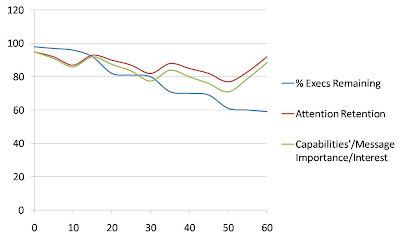
In any case, a recent Great Demo! Workshop participant noted that in the Great Demo! Attention-Retention graph, I show executives actually returning to the room, after previously leaving. While possible, this is not very likely - and is an error in my plot.
Here's the corrected graph, using the orginal data:
That looks much more reasonable...!
Arriving 15 Minutes Ahead of Time
When I recommend, in Great Demo! Workshops, that you plan to “arrive” 15 minutes ahead of time for a Remote Demo, I often see a combination of confusion (in some people) and recognition (in others). I realized that a simple way to explain the idea is as follows:
For a face-to-face meeting, do you typically try to arrive 15 minutes early? If so, why? Most typically, Workshop participants respond:
- So that we’re not late…!
- So that we can set up and be prepared when the meeting starts [the right answer]…
- So that we can meet and mix with the audience [also a good answer]…
- So that we can meet with the principal(s) to make capture any changes in the plan, objectives, or participants [another good answer]…
For Remote Demos, why should this be any different?
In other words, treat your Remote Demo session (when possible) the same way you would a face-to-face demo and “arrive” at the meeting 15 minutes ahead of the formal starting time.
“Arriving” means coordinating with a customer Champion, Sponsor, or other key player – or a colleague at your organization who will be at the customer’s site – ahead of time, and setting the collaboration tool meeting (e.g., WebEx, Live Meeting, etc.) for 15 minutes ahead of the formal start.
That will give you time to ensure that the collaboration tool is working properly, that the audio is OK, and then to still have time to run through the other reasons listed above.
Monday, March 24, 2008
Auto-Demo Hell
[This article was contributed by Doug Nugent, writing on behalf of The Second Derivative]
We’ve all experienced some sort of software demo hell, either as a member of the audience, or, more painfully, as the presenter. But the days of live demo hell are slowly beginning to disappear. Presenters are more savvy and strategic in how and what they present, and as a result audiences are being spared the torture. But unfortunately, we are now entering the era of auto-demo hell.
With the advent of Software-as-a-Service –designed for easier access (no installation), a lower price-point (single users), and a global reach (multiple languages), the opportunity, or more importantly the business case, cannot justify the personnel needed to perform live demos –either in person, or over the web. Hence the rise of the automated demo.
Online automated demos have traditionally fallen into the marketing strategy, but they’re quickly becoming a significant, if not the primary component of the sales strategy. Like it or not, automated online demos are making or breaking the sale, and unless companies trying to sell their software services can justify a highly skilled sales force (or the ever-popular, but risky sales channel), sales are destined to mediocrity.
“Our demos are excellent, we only get positive feedback” you say? Of course, because you’re only hearing from people who’ve purchased –the lowest possible hanging fruit. How many people drop-off before the end of the demo? One of the beauties of automated demos is the ability to track their success , especially when they incorporate a “Buy Now” button. But the objective of course is to maximize the crop. Consider these current challenges:
We’ve all experienced some sort of software demo hell, either as a member of the audience, or, more painfully, as the presenter. But the days of live demo hell are slowly beginning to disappear. Presenters are more savvy and strategic in how and what they present, and as a result audiences are being spared the torture. But unfortunately, we are now entering the era of auto-demo hell.
With the advent of Software-as-a-Service –designed for easier access (no installation), a lower price-point (single users), and a global reach (multiple languages), the opportunity, or more importantly the business case, cannot justify the personnel needed to perform live demos –either in person, or over the web. Hence the rise of the automated demo.
Online automated demos have traditionally fallen into the marketing strategy, but they’re quickly becoming a significant, if not the primary component of the sales strategy. Like it or not, automated online demos are making or breaking the sale, and unless companies trying to sell their software services can justify a highly skilled sales force (or the ever-popular, but risky sales channel), sales are destined to mediocrity.
“Our demos are excellent, we only get positive feedback” you say? Of course, because you’re only hearing from people who’ve purchased –the lowest possible hanging fruit. How many people drop-off before the end of the demo? One of the beauties of automated demos is the ability to track their success , especially when they incorporate a “Buy Now” button. But the objective of course is to maximize the crop. Consider these current challenges:
- Online automated demos are often produced by the marketing department, and are designed to present the entire product in one fell swoop. Not to ‘dis the marketing team, but in the live demo world this would be considered the “shotgun” approach (aka “harbor tour” or “show-up and throw-up”), and is likely to result in a significant and rapid viewer drop-off rate.
- Again, as one of marketing’s key objectives, automated demos are often a presentation of features. Sure, features are great, but features don’t sell.
- Automated demos are usually dry, un-engaging and difficult to relate to. But remember, low-cost SaaS solutions often get purchased by end-users (=emotional).
- Automated demos cover a plethora of features all at once – the majority of which might not matter to the viewer. And if the most important feature (reason for buying) is buried at the end of the demo…goodbye.
- When the demo ends, what’s the call-to-action? Most likely it’s “here’s our number/email… pleeeease call us”, and if there hasn’t been a required preregistration process (burdensome to most viewers), how can you possibly followup?
So, we can now agree –automated demos are critical for sales, and without a more strategic approach, online demos are only cherry-picking. Here are a few best practices you may want to consider when preparing the online automated demo.
- Gear the demo to the benefits, not the features – it’s the benefits that sell.
- Know your audience, and customize individual demos or content that can be easily navigated to for the majority of decision-makers. Pin-pointing specific benefits to the appropriate viewers will keep them engaged.
- Know the business issues you’re addressing, and let ‘em know you know –right at the beginning. “Hey, they’re sharing my pain!”
- Tell a story – specifically a story each viewer role can relate to. Again, it will keep them engaged, and will help them visualize using, and benefiting from the product themselves.
- Make sure the story presents compelling reasons for them to change from what they’re doing now…“Wow, how have I lived without this!”
- Show the conclusion at the beginning. Sure, the conclusion is usually the payoff at the end of the story, but the worst case will be that someone discovers they’re looking at the wrong demo, and can re-direct themselves. The best, and most common result will be a hooked viewer. They’ll see the final result and will want to know how the heck they can get there. As Michael Bosworth (sales methodology expert) describes it, it will fill them with hope and curiosity - Hope that it will work for them, and curiosity about how.
- Close, and close early - make sure there’s a “Buy Now”button on every page. Give every customer the ability to close the sale when they’re ready –not when the demo ends.
These are but a few, albeit critical components to making the most out of automated demos. And keep in mind, they only become increasingly important as the entry cost lowers, and the audience widens (other languages, industries, business processes…). The one key fundamental rule to remember –demo to your audience and their specific needs – and let the demo do some selling.
Friday, March 21, 2008
Seven Thoughts or Processes
Cognitive neurologists (and psychologists) have empirically determined that typical humans can work with up to seven ideas or processes at one time. This appears to be a natural limitation of our short-term memory mechanics.
It is important to consider this when preparing demos – any demo that asks the audience to track more than seven ideas at once is (generally speaking) doomed to fail. Or, at least, it should be expected that the audience will lose track of any material that goes beyond the seven ideas limit.
In addition, bear in mind that your audience may not grant access to all seven “registers” – after all, there are other things going on in their day that they are most likely tracking as well. With this in mind, it (once again!) suggests that one should organize demos to be presented in consumable components that can be presented and easily assimilated with the remaining registers that are available.
An illustrative exercise is to contemplate you own workday – right now. How many ideas are you juggling or working on concurrently? Write them down. Now, how many “registers” are left for new information coming from someone else’s demo?
It is important to consider this when preparing demos – any demo that asks the audience to track more than seven ideas at once is (generally speaking) doomed to fail. Or, at least, it should be expected that the audience will lose track of any material that goes beyond the seven ideas limit.
In addition, bear in mind that your audience may not grant access to all seven “registers” – after all, there are other things going on in their day that they are most likely tracking as well. With this in mind, it (once again!) suggests that one should organize demos to be presented in consumable components that can be presented and easily assimilated with the remaining registers that are available.
An illustrative exercise is to contemplate you own workday – right now. How many ideas are you juggling or working on concurrently? Write them down. Now, how many “registers” are left for new information coming from someone else’s demo?
Monday, March 17, 2008
The B Key
When someone is presenting using PowerPoint, where is your eye typically forced to go? Most likely, you will find yourself staring at the screen (no matter what is on it!). This is one of the aspects of the "tyranny of PowerPoint".
If you are presenting, however, and you want to make an important point - or add drama to your presentation - try using the "B" key.
In Slideshow mode the “B” key toggles between the presentation and a blank (black) screen (it doesn’t matter if you use upper or lower case – simply pressing the key executes the toggle).
Using the "B" key provides you with the opportunity to direct attention to yourself (and away from the PowerPoint slides). This can help you to make critical points, move to a whiteboard for an ad hoc drawing or to develop a concept, or otherwise break up the standard PowerPoint slide-after-slide-after-slide presentation!
If you are presenting, however, and you want to make an important point - or add drama to your presentation - try using the "B" key.
In Slideshow mode the “B” key toggles between the presentation and a blank (black) screen (it doesn’t matter if you use upper or lower case – simply pressing the key executes the toggle).
Using the "B" key provides you with the opportunity to direct attention to yourself (and away from the PowerPoint slides). This can help you to make critical points, move to a whiteboard for an ad hoc drawing or to develop a concept, or otherwise break up the standard PowerPoint slide-after-slide-after-slide presentation!
Thursday, March 6, 2008
The Dreaded “If”
There are a handful of phrases that put fear and loathing into my heart when I’m on the receiving end of a demo – here are a few:
“…Let me start by orienting you to our navigation and layout…”
Oh my god. I don’t what to learn how to use your software yet; I don’t even know if it does anything that will help my business. The last thing I want at this point is product training!
“…Now I’ll show you our context-relevant help system…”
Double oh my god. This suggests that I’ll need the help system, because your software is complex, complicated, and downright user-hostile.
“…and another really cool thing about our software is…”
This phrase is used, often frequently, in what are known as “run-on demos”. These are demos without a break, without a pause, and typically no introduction or summary for any particular segment. These demos are one-way, painful tirades from presenter to audience.
The phrase above strikes terror into the heart of typical audience members because it really means, “now I’m going to show you something else that you likely don’t need and aren’t interested in, but you can’t escape while I’m still talking…!”
“…and the next thing I want to show you is…”
Ditto.
“…If…”
The dreaded “if”. It starts innocuously enough, with a single “if”, such as, “Now, if you want to submit it then you choose ‘OK’…” But “if” appears to need company, and will clone itself…repeatedly! Here’s an example:
“Now, if you want to submit it then you choose ‘OK’… But if you want to change the color, then you go to our color palette which I’ll show you now…, or if you need different sizes, then you click here where we have our sizing wizard which operates like this…, and if you want to share it with other colleagues then let me show you our collaboration tool…”
It may never stop!
The dreaded “if” generally precedes an exhausting, interminable review of all possible options and choices, shown to the audience in excruciating detail.
When you find you are about to say “if” in a demo, consider asking the audience if they are interested in seeing the capabilities you have in mind before proceeding!
“…Let me start by orienting you to our navigation and layout…”
Oh my god. I don’t what to learn how to use your software yet; I don’t even know if it does anything that will help my business. The last thing I want at this point is product training!
“…Now I’ll show you our context-relevant help system…”
Double oh my god. This suggests that I’ll need the help system, because your software is complex, complicated, and downright user-hostile.
“…and another really cool thing about our software is…”
This phrase is used, often frequently, in what are known as “run-on demos”. These are demos without a break, without a pause, and typically no introduction or summary for any particular segment. These demos are one-way, painful tirades from presenter to audience.
The phrase above strikes terror into the heart of typical audience members because it really means, “now I’m going to show you something else that you likely don’t need and aren’t interested in, but you can’t escape while I’m still talking…!”
“…and the next thing I want to show you is…”
Ditto.
“…If…”
The dreaded “if”. It starts innocuously enough, with a single “if”, such as, “Now, if you want to submit it then you choose ‘OK’…” But “if” appears to need company, and will clone itself…repeatedly! Here’s an example:
“Now, if you want to submit it then you choose ‘OK’… But if you want to change the color, then you go to our color palette which I’ll show you now…, or if you need different sizes, then you click here where we have our sizing wizard which operates like this…, and if you want to share it with other colleagues then let me show you our collaboration tool…”
It may never stop!
The dreaded “if” generally precedes an exhausting, interminable review of all possible options and choices, shown to the audience in excruciating detail.
When you find you are about to say “if” in a demo, consider asking the audience if they are interested in seeing the capabilities you have in mind before proceeding!
Saturday, March 1, 2008
Semi-Shameless Self-Promotion
Here's a semi-shameless self-promotional announcement:
I'll be delivering a Great Demo! Workshop on Saturday March 8 in San Jose, California.
This is a "public" Workshop, open to any and all interested parties. The Workshop is organized in two parts:
So how is this "semi-shameless"? I'm doing the Workshop in conjunction with and on behalf of SKMurphy, Inc. - and the Workshop is designed for small start-up organizations (e.g., a few people) as opposed to larger businesses (e.g., Microsoft).
My typical target audience are B-to-B software companies with a substantial field organization and the Workshops are nearly always non-public, specifically oriented to each customers' situation. This Workshop, on the other hand, focuses on helping start-ups create demos that will help them get their first few customers (in many cases), and/or re-tune their "pitch" from investors to customers, and/or similarly re-tune their pitch from early adopters to majority customers.
While start-ups are the target audience for this Workshop, individuals from larger organizations are welcome and will find the material extraordinarily useful...! In any case, this is a terrific opportunity to learn some new ideas and put them into practice.
I'll be delivering a Great Demo! Workshop on Saturday March 8 in San Jose, California.
This is a "public" Workshop, open to any and all interested parties. The Workshop is organized in two parts:
- Great Demo! Workshop - running from 8:30 AM - 1:00 PM, Saturday March 8, at the Moorpark Hotel in San Jose, CA. Registration information and more details can be found here: http://www.skmurphy.com/services/workshops/cohans-great-demos/. And the price? $60 (can't beat this, frankly...!).
- Great Demo! Advanced Topics - picks up when the first half ends, starting at 1:00 PM and ending at 5:00 PM. Registration and further information is at the following URL: http://www.skmurphy.com/services/workshops/cohans-advanced-topics. And the price for this segment is also $60.
So how is this "semi-shameless"? I'm doing the Workshop in conjunction with and on behalf of SKMurphy, Inc. - and the Workshop is designed for small start-up organizations (e.g., a few people) as opposed to larger businesses (e.g., Microsoft).
My typical target audience are B-to-B software companies with a substantial field organization and the Workshops are nearly always non-public, specifically oriented to each customers' situation. This Workshop, on the other hand, focuses on helping start-ups create demos that will help them get their first few customers (in many cases), and/or re-tune their "pitch" from investors to customers, and/or similarly re-tune their pitch from early adopters to majority customers.
While start-ups are the target audience for this Workshop, individuals from larger organizations are welcome and will find the material extraordinarily useful...! In any case, this is a terrific opportunity to learn some new ideas and put them into practice.
Wednesday, February 27, 2008
Why Don’t They “Get It”?
This is a draft of an article targeted towards start-ups and teams releasing new, breakthrough products - comments and feedback welcomed!
Why Don’t They “Get It” – Are They Stupid Or What?
Have you ever delivered a demo to a prospect that doesn’t seem to understand what you are offering them? Have you ever had a prospect say, at the end of a demo, “Um, hmmm, looks interesting; we’ll get back to you later…” (and you never hear from them again)?
Have you ever felt like the prospect just didn’t “get it” – that they didn’t appear to have a clue as to what earth-shattering game-changing breakthrough you’d just shown them? Are they stupid or what?
But Things Were Going So Well…
Here’s what often happens: you create a dynamite new offering that will change the world (for the better). You show it in early demos to some like-minded people who get really excited about it – they see the promise implied; they see what amazing solutions it can provide to their companies; they visualize a broad range applications and implementations.
They “get it”. Even better, they may buy it – in its early stage of release, with warts, blemishes, future promises and all. They support and nurture your product’s initial uses in their companies – and you have your first one or two customers as a result. Congratulations!
You’re so excited, you take your offering on the road (and begin dreaming of sales forecasts that need a log scale to plot…). You expect that nearly every new prospect will be just as visionary as your first few sales.
At the first new prospect you deliver the same presentation and demo you did earlier – but this prospect doesn’t get excited. They don’t say much of anything, in fact. It is clear that they just don’t “get it”.
“Well, maybe they’re just stupid…” you mutter to yourself, and move on to your next prospect. Unfortunately (and frustratingly), the same thing happens again. And again, with the next prospect. What’s happening? Can they all be that clueless?
Welcome To the Chasm
It’s time to dust off and re-read that Silicon Valley classic book Crossing the Chasm by Geoffrey Moore. Sure, you remember the various categories from the book: Innovators, Early Adopters, Early Majority, Late Majority and Laggards.
It is likely that your first few enthusiastic customers were Innovators or Early Adopters – they love your new technology, your novel application, and they understand what problems can be addressed by your offering.
Interesting – and importantly – they understand this even though they were only shown the solution your product provides. They make the leap from seeing solutions to the underlying problems on their own. This is what makes them Innovators and Early Adopters – they “get it”.
The reason you failed to connect with your next wave of prospects is that they are likely Majority people. You’ve presented a solution to people who don’t even know they have a problem. It is not that they are stupid, they just don’t “get it” – yet…
Why Are You Reaching For My Face?
Have you ever been sharing a meal with a colleague or family member and noted that they had a bit of food stuck near their lips – just hanging there? You watch it (mesmerized…!) for a minute and then often reach out with a napkin to wipe it off their face. You see the problem that they didn’t even realize they have (dollop of cheesecake on their cheek) – and are offering a solution (wiping the offending bit of food away).
It is perfectly obvious to you – but it may be totally unclear to your partner why you are reaching towards their face with a napkin. Their first response will likely be confusion – or even concern! (“What are you doing with that napkin…?”)
On the other hand, if you first let them know they have a problem, then they will be much more willing to explore a solution:
“Bob, you have some cheesecake on your cheek…”
“I do?” Bob wipes with his napkin, but misses….
“Bob, it’s still there – would you like me to wipe it off for you?”
“Yes, please…”
The same situation exists with Majority prospects. They often don’t realize they have a problem, to start with. In many cases, the solution your offering provides solves a problem that they have been living with for years. They assume that life with this problem is simply the status quo.
Typical presentations and demos from early stage companies often assume that the prospect knows that they have a problem and that the prospect is interested in solving it. That is the big disconnect. You show a terrific vision of a solution – but your customer doesn’t understand the context. They’re thinking, “Why am I watching this? Where is this going?”
How can you possibly show a solution when they don’t even know they have a problem?
Step Zero: Let Them Know They Have a Problem
When presenting to Majority prospects, your first step is to let them know they have a problem – and help them understand the value of solving it. A terrific way to do this is through the use of informal success stories, often harvested from your interactions with your first few customers.
Here’s an example:
Let’s say that you have an offering that can find, aggregate and deliver content from any electronic source directly into a web portal, and automatically organize the order of delivery by topic relevance. Further, it can track what a user consumes, including how long a user stays on any particular piece of content and how far each user reviews it.
Sounds like a terrific piece of technology, right? Maybe…. Let’s explore what happens when you present the solution first vs. presenting the problem first:
Solution First Approach for Majority Prospects [That worked well for Innovators and Early Adopters] – let’s say you are demonstrating your tool to the VP of Sales:
You say, “Look at this great tool… It just collected a pile of content from your corporate intranet and the external internet, organized it, sorted it according to relevance, and then presented it through this web portal. Really cool, huh?”
VP of Sales Prospect says, “But I already use Google… Why would I want another Google-like tool?”
You think, “Clueless clone, you and your company are doomed to dinosaur demises…!”
Problem First Approach for Majority Prospects – again, you are in a conversation with the VP of Sales:
You say, “Let me share how we helped other sales vice presidents achieve their quarterly and annual numbers…”
VP of Sales Prospect says, “I’m interested…!”
You continue, “Other sales VP’s told us it was taking far too long to bring new hires up-to-speed. In many cases, it took months for new sales hires to become effective – yet these new hires were carrying the same quota as those who were already up-to-speed. The result was that sales VP’s were at risk of missing their numbers. How does this compare with your situation?”
VP of Sales Prospect says, “I’m in a very similar situation. We just hired 12 new sales staff and I assume that it’ll take months for them to become effective – that’s just the way it is…”
You say, “Well, the sales VP’s we’ve worked with said that they wanted some way to pull together sales-relevant information – situation and business information, sales tools, product information and internal best sales practices. They said this information was scattered all around the company and outside – it was hard to bring together and even harder to organize in context and present in a logical order.”
VP of Sales Prospect says, “That sounds very familiar!”
You say, “Well, we provided those capabilities. Now, these sales VP’s have reduced new hire training time from months down to a few weeks – and are much more comfortable in making their quarterly and annual numbers.”
VP of Sales Prospect says, “Wow – it would be great to have that… What does it look like?”
You say, “Would you like to see a brief demo to give you an idea of how it could work for you?”
VP of Sales Prospect says, “Yes, please!”
You are now well along your way to securing your first Majority customer – congratulations!
And the Moral Is…
You can’t show a solution to someone who doesn’t perceive they have a problem. Your first step when presenting your new offering to Majority prospects is to help them understand that they have a problem – and that the problem is both important and can be solved. Informal success stories, harvested from your Early Adopter or Innovator experiences, provides excellent material to draw from.
Make sure your prospects know they have a problem (and want to solve it) before you offer a solution!
Copyright © 2008 The Second Derivative – All Rights Reserved.
For more articles on demonstration effectiveness skills and methods, visit our website at www.SecondDerivative.com. For demo tips, best practices, tools and techniques, join the DemoGurus Community Website at www.DemoGurus.com. For more information go to www.SecondDerivative.com or register at www.DemoGurus.com.
Have you ever delivered a demo to a prospect that doesn’t seem to understand what you are offering them? Have you ever had a prospect say, at the end of a demo, “Um, hmmm, looks interesting; we’ll get back to you later…” (and you never hear from them again)?
Have you ever felt like the prospect just didn’t “get it” – that they didn’t appear to have a clue as to what earth-shattering game-changing breakthrough you’d just shown them? Are they stupid or what?
But Things Were Going So Well…
Here’s what often happens: you create a dynamite new offering that will change the world (for the better). You show it in early demos to some like-minded people who get really excited about it – they see the promise implied; they see what amazing solutions it can provide to their companies; they visualize a broad range applications and implementations.
They “get it”. Even better, they may buy it – in its early stage of release, with warts, blemishes, future promises and all. They support and nurture your product’s initial uses in their companies – and you have your first one or two customers as a result. Congratulations!
You’re so excited, you take your offering on the road (and begin dreaming of sales forecasts that need a log scale to plot…). You expect that nearly every new prospect will be just as visionary as your first few sales.
At the first new prospect you deliver the same presentation and demo you did earlier – but this prospect doesn’t get excited. They don’t say much of anything, in fact. It is clear that they just don’t “get it”.
“Well, maybe they’re just stupid…” you mutter to yourself, and move on to your next prospect. Unfortunately (and frustratingly), the same thing happens again. And again, with the next prospect. What’s happening? Can they all be that clueless?
Welcome To the Chasm
It’s time to dust off and re-read that Silicon Valley classic book Crossing the Chasm by Geoffrey Moore. Sure, you remember the various categories from the book: Innovators, Early Adopters, Early Majority, Late Majority and Laggards.
It is likely that your first few enthusiastic customers were Innovators or Early Adopters – they love your new technology, your novel application, and they understand what problems can be addressed by your offering.
Interesting – and importantly – they understand this even though they were only shown the solution your product provides. They make the leap from seeing solutions to the underlying problems on their own. This is what makes them Innovators and Early Adopters – they “get it”.
The reason you failed to connect with your next wave of prospects is that they are likely Majority people. You’ve presented a solution to people who don’t even know they have a problem. It is not that they are stupid, they just don’t “get it” – yet…
Why Are You Reaching For My Face?
Have you ever been sharing a meal with a colleague or family member and noted that they had a bit of food stuck near their lips – just hanging there? You watch it (mesmerized…!) for a minute and then often reach out with a napkin to wipe it off their face. You see the problem that they didn’t even realize they have (dollop of cheesecake on their cheek) – and are offering a solution (wiping the offending bit of food away).
It is perfectly obvious to you – but it may be totally unclear to your partner why you are reaching towards their face with a napkin. Their first response will likely be confusion – or even concern! (“What are you doing with that napkin…?”)
On the other hand, if you first let them know they have a problem, then they will be much more willing to explore a solution:
“Bob, you have some cheesecake on your cheek…”
“I do?” Bob wipes with his napkin, but misses….
“Bob, it’s still there – would you like me to wipe it off for you?”
“Yes, please…”
The same situation exists with Majority prospects. They often don’t realize they have a problem, to start with. In many cases, the solution your offering provides solves a problem that they have been living with for years. They assume that life with this problem is simply the status quo.
Typical presentations and demos from early stage companies often assume that the prospect knows that they have a problem and that the prospect is interested in solving it. That is the big disconnect. You show a terrific vision of a solution – but your customer doesn’t understand the context. They’re thinking, “Why am I watching this? Where is this going?”
How can you possibly show a solution when they don’t even know they have a problem?
Step Zero: Let Them Know They Have a Problem
When presenting to Majority prospects, your first step is to let them know they have a problem – and help them understand the value of solving it. A terrific way to do this is through the use of informal success stories, often harvested from your interactions with your first few customers.
Here’s an example:
Let’s say that you have an offering that can find, aggregate and deliver content from any electronic source directly into a web portal, and automatically organize the order of delivery by topic relevance. Further, it can track what a user consumes, including how long a user stays on any particular piece of content and how far each user reviews it.
Sounds like a terrific piece of technology, right? Maybe…. Let’s explore what happens when you present the solution first vs. presenting the problem first:
Solution First Approach for Majority Prospects [That worked well for Innovators and Early Adopters] – let’s say you are demonstrating your tool to the VP of Sales:
You say, “Look at this great tool… It just collected a pile of content from your corporate intranet and the external internet, organized it, sorted it according to relevance, and then presented it through this web portal. Really cool, huh?”
VP of Sales Prospect says, “But I already use Google… Why would I want another Google-like tool?”
You think, “Clueless clone, you and your company are doomed to dinosaur demises…!”
Problem First Approach for Majority Prospects – again, you are in a conversation with the VP of Sales:
You say, “Let me share how we helped other sales vice presidents achieve their quarterly and annual numbers…”
VP of Sales Prospect says, “I’m interested…!”
You continue, “Other sales VP’s told us it was taking far too long to bring new hires up-to-speed. In many cases, it took months for new sales hires to become effective – yet these new hires were carrying the same quota as those who were already up-to-speed. The result was that sales VP’s were at risk of missing their numbers. How does this compare with your situation?”
VP of Sales Prospect says, “I’m in a very similar situation. We just hired 12 new sales staff and I assume that it’ll take months for them to become effective – that’s just the way it is…”
You say, “Well, the sales VP’s we’ve worked with said that they wanted some way to pull together sales-relevant information – situation and business information, sales tools, product information and internal best sales practices. They said this information was scattered all around the company and outside – it was hard to bring together and even harder to organize in context and present in a logical order.”
VP of Sales Prospect says, “That sounds very familiar!”
You say, “Well, we provided those capabilities. Now, these sales VP’s have reduced new hire training time from months down to a few weeks – and are much more comfortable in making their quarterly and annual numbers.”
VP of Sales Prospect says, “Wow – it would be great to have that… What does it look like?”
You say, “Would you like to see a brief demo to give you an idea of how it could work for you?”
VP of Sales Prospect says, “Yes, please!”
You are now well along your way to securing your first Majority customer – congratulations!
And the Moral Is…
You can’t show a solution to someone who doesn’t perceive they have a problem. Your first step when presenting your new offering to Majority prospects is to help them understand that they have a problem – and that the problem is both important and can be solved. Informal success stories, harvested from your Early Adopter or Innovator experiences, provides excellent material to draw from.
Make sure your prospects know they have a problem (and want to solve it) before you offer a solution!
Copyright © 2008 The Second Derivative – All Rights Reserved.
For more articles on demonstration effectiveness skills and methods, visit our website at www.SecondDerivative.com. For demo tips, best practices, tools and techniques, join the DemoGurus Community Website at www.DemoGurus.com. For more information go to www.SecondDerivative.com or register at www.DemoGurus.com.
Tuesday, February 26, 2008
Article Drafts and Previews
A great use of a blog is to provide the opportunity for dialog on new content - with that in mind, I'll plan to post drafts of new articles for your review, comments, and amusement. Looking forward to your thoughts...
Along the same lines, I welcome suggestions you offer for article ideas or topics - what's important to you?
Along the same lines, I welcome suggestions you offer for article ideas or topics - what's important to you?
Monday, February 25, 2008
Attention Retention and Demos
When does your audience pay the most attention in your demos? At the beginning? In the middle? At the end? When do they pay the least attention...? And what do they really remember from your demos?
A simple exercise may provide answers that surprise you and convince you to consider “turning your demos upside down” – to improve the win rates for your demos.
A List of Ten Words
Here is a terrific experiment to run on your own:
Create a list of ten words. Now gather a group of ten or more people together. Tell them, “I am going to read a list of ten words – please listen to them carefully…”
Read the list deliberately, then pause a few seconds and say, “Now please write down as many as you can remember…” Let them write as many words as they can (no cheating, please!).
Now create a grid with 10 columns and as many rows as there are people in your group. Poll your group to determine how many people wrote down each word on your list. The resulting plot will most likely look like the following (we used 20 people in our group):
A simple exercise may provide answers that surprise you and convince you to consider “turning your demos upside down” – to improve the win rates for your demos.
A List of Ten Words
Here is a terrific experiment to run on your own:
Create a list of ten words. Now gather a group of ten or more people together. Tell them, “I am going to read a list of ten words – please listen to them carefully…”
Read the list deliberately, then pause a few seconds and say, “Now please write down as many as you can remember…” Let them write as many words as they can (no cheating, please!).
Now create a grid with 10 columns and as many rows as there are people in your group. Poll your group to determine how many people wrote down each word on your list. The resulting plot will most likely look like the following (we used 20 people in our group):
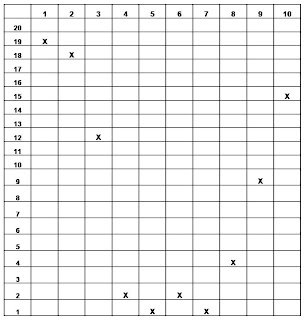
Wow…! What does this mean? It means that most people hear the first few things you say, then they rapidly lose track. The middle portion of what you present is essentially lost. Finally, at the very end of your list your audience regains an increased level of retention – but not as high as at the beginning. This should be both very instructive – and very frightening!
If you draw a rough curve through the “x’s” in your plot above, you’ll get what is called the “Attention-Retention1” curve – and it clearly shows why traditional demos are at risk.
Traditional Demos and Attention-Retention
In a typical demo, the presenter often begins by “orienting” the audience to the software. This may include how to log in (yawn), the layout of the menus and navigation tools (yawn again), the ability to customize the “home” screen (looonnnng yawn), and an introduction to the context-sensitive help system (snore…).
This banal opening is then followed by introducing the names of several fictional characters and a long, convoluted demo that embraces multiple customer roles and multiple workflows. Interruptions and questions take the demonstrator down “rat holes” and off your agenda into areas of interest only to a limited few in the audience.
Finally, after far-too-many minutes, the presenter reaches the end-points for the various workflows and then discusses the broad range of pre-built, yet flexible reports that are available in the package (but doesn’t show any that are particularly interesting).
What has happened to the audience’s attention during this process?
At the beginning, when audience attention was highest, the presenter squandered that opportunity by presenting some of the least interesting aspects of the offering. The audience quietly tuned-out for much of the middle portion and then finally perked up towards the end of the demo when they realized that their torture was about to end!
Based on the Attention-Retention curve we created above, what did the audience remember from the demo? Most likely, they remembered two areas:
1. They remembered a good portion of how to navigate, generally, through the software; and
2. That there is a huge number of potentially confusing reports to wade through…
Was this a successful demo? Most likely not!
Elvis Has Left the Room
But that isn’t the worst part. When do your customers’ high-ranking people arrive at a demo meeting and when do they leave (e.g., C-level, VP’s, Senior Directors…)?
If you answered, “late and early” you are both cynical and largely correct!
High-ranking participants at demo meetings typically arrive just about right on time. They often take a seat, quietly, in the rear of the room. They may ask a question or two. But if they don’t see something that compels their interest, they’ll typically leave after 10-20 minutes.
Given our traditional demo above, it is rather likely that the high-ranking executives won’t stay very long. Even worse, they’ll only see (and remember) some of the least important aspects of your offering.
Here’s a graphical view of what happens in a traditional demo:
If you draw a rough curve through the “x’s” in your plot above, you’ll get what is called the “Attention-Retention1” curve – and it clearly shows why traditional demos are at risk.
Traditional Demos and Attention-Retention
In a typical demo, the presenter often begins by “orienting” the audience to the software. This may include how to log in (yawn), the layout of the menus and navigation tools (yawn again), the ability to customize the “home” screen (looonnnng yawn), and an introduction to the context-sensitive help system (snore…).
This banal opening is then followed by introducing the names of several fictional characters and a long, convoluted demo that embraces multiple customer roles and multiple workflows. Interruptions and questions take the demonstrator down “rat holes” and off your agenda into areas of interest only to a limited few in the audience.
Finally, after far-too-many minutes, the presenter reaches the end-points for the various workflows and then discusses the broad range of pre-built, yet flexible reports that are available in the package (but doesn’t show any that are particularly interesting).
What has happened to the audience’s attention during this process?
At the beginning, when audience attention was highest, the presenter squandered that opportunity by presenting some of the least interesting aspects of the offering. The audience quietly tuned-out for much of the middle portion and then finally perked up towards the end of the demo when they realized that their torture was about to end!
Based on the Attention-Retention curve we created above, what did the audience remember from the demo? Most likely, they remembered two areas:
1. They remembered a good portion of how to navigate, generally, through the software; and
2. That there is a huge number of potentially confusing reports to wade through…
Was this a successful demo? Most likely not!
Elvis Has Left the Room
But that isn’t the worst part. When do your customers’ high-ranking people arrive at a demo meeting and when do they leave (e.g., C-level, VP’s, Senior Directors…)?
If you answered, “late and early” you are both cynical and largely correct!
High-ranking participants at demo meetings typically arrive just about right on time. They often take a seat, quietly, in the rear of the room. They may ask a question or two. But if they don’t see something that compels their interest, they’ll typically leave after 10-20 minutes.
Given our traditional demo above, it is rather likely that the high-ranking executives won’t stay very long. Even worse, they’ll only see (and remember) some of the least important aspects of your offering.
Here’s a graphical view of what happens in a traditional demo:
Traditional Demonstration – Interest vs. Time Plot
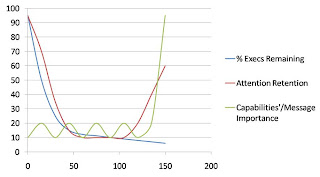
Summary? In traditional demos, many of the most important capabilities and messages are delivered towards the end of the demo – when Executives are often gone and interest is only moderate. Is there an alternative approach that yields better results? Why, yes indeed!
Do the Last Thing First
The Great Demo! method is based on turning a traditional demo upside down. A Great Demo! starts off with the biggest “Wow!” for the targeted audience members right at the beginning, then peels back the layers of your offering in accord with the audience’s depth and level of interest.
By starting with the most interesting aspect of the software – the pay-off – your audience becomes more interested and attention-retention improves. Making the demo a “conversation” with your audience, rather than a “presentation”, also improves attention. Questions are more focused and less likely to come from “hostiles”.
Interestingly, execs tend to stay longer in the room when the Great Demo! strategy is employed and these executives are more engaged. Equally interestingly, practitioners of the method report that the overall length of their demos are shorter.
Most importantly, organizations that have adopted Great Demo! report that their win rates increase and that they do fewer demos overall to get the business.
Here’s a graphical view of the Attention-Retention curves in a Great Demo!
Great Demo! – Interest vs. Time Plot
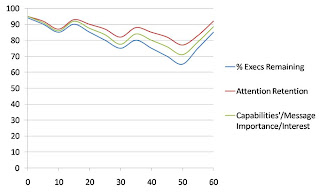
The curves tend to stay tightly together for the first 6-8 minutes. Starting with the pay-off engages your audience right away – you can actually see people learn forward in their seats!
As audience members begin to participate in the demo conversation (“That screen is great – can it be modified to show more columns…?”), interest oscillates in small waves. By summarizing as you conclude each section, you cause attention and information retention to increase.
A final summary at the end of the demo, recapping the highlights of the material presented, tends to drive attention levels upwards again – you can often see people nodding their heads in agreement as you summarize.
The moral? Contemplate turning your demos upside demo and enjoy higher win rates!
1 The Attention-Retention curve and exercise was developed by Michael Blanchette and is used with his permission.
Copyright © 2008 The Second Derivative – All Rights Reserved.
For more articles on demonstration effectiveness skills and methods, visit our website at http://www.secondderivative.com/. For demo tips, best practices, tools and techniques, join the DemoGurus Community Website at http://www.demogurus.com/. For more information go to http://www.secondderivative.com/ or register at http://www.demogurus.com/.
Subscribe to:
Posts (Atom)